


ACADEMICIAN S. CHULUUN: ZANABAZAR REFLECTED THE RELATIONSHIP BETWEEN NOMADIC CULTURE, THE LAND AND NATURE IN HIS WORKS
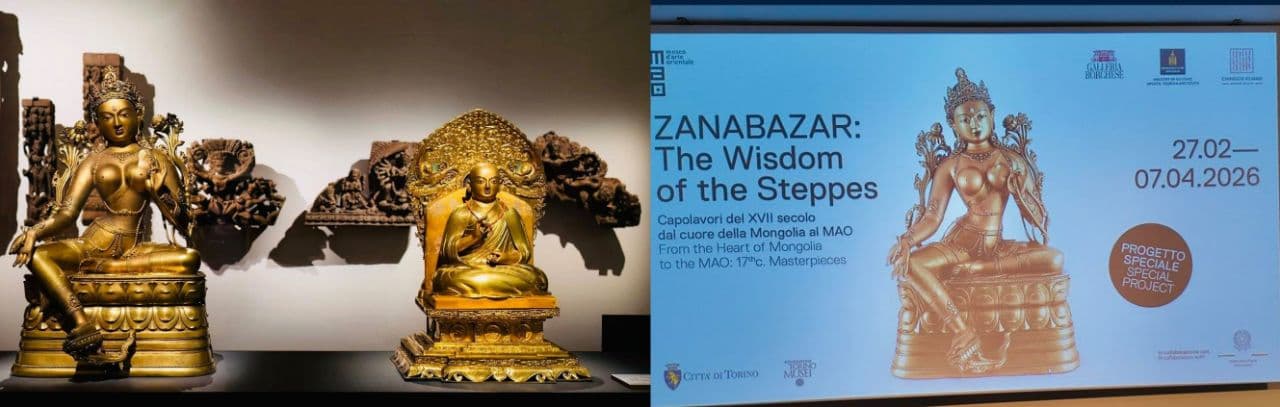
The special exhibition “Zanabazar: The Wisdom of the Steppe”, dedicated to Undur Gegeen Zanabazar, opened on February 26, 2026, at the Museum of Oriental Art (MAO) in Turin, Italy.
The exhibition had previously been presented about a month ago at the Galleria Borghese in Rome. Depending on the characteristics of the museum, the concept was reflected in different ways. For example, at the Galleria Borghese, two of Zanabazar’s works, Green Tara and Portrait of Undur Gegeen Zanabazar were displayed in the Mariano Rossi Hall alongside works by the renowned Baroque sculptor Gian Lorenzo Bernini. It was an event that brought together in one space great artists who created masterpieces of art in the East and West at the same time, with their works that are still famous today. The exhibition also established a unique environment encouraging dialogue between the artworks and viewers by highlighting both the differences and similarities among the works, as well as their techniques, craftsmanship, and distinctive modes of thought.
The two artworks of this time are exhibited in the hall presenting the art of South, Central Asia and the Himalayan region. They are unique in that they are displayed alongside other works included in the museum's collection, especially those related to the Densatil Monastery in Tibet, and ancient art relics that have had a significant impact on the design and image of Zanabazar's artwork.
Speaking at the exhibition opening were Mr. Massimo Broccio, President of the museum foundation of the city, Davide Quadrio, Director of the Museum of Oriental Art (MAO), and Academician S. Chuluun, Director of the Chinggis Khaan National Museum.
Academician S. Chuluun explained in his opening speech, “The works of Zanabazar, born on the vast steppes of the East, are now visiting the foothills of the Alpine mountains. Zanabazar, a noble descendant of Chinggis Khaan, created his masterpieces on the Mongolian steppe, reformed religious traditions, and established many magnificent monasteries. The Soyombo script he created remains the national symbol of Mongolia to this day. The 340th anniversary of this symbol will be commemorated in 2026. Not only did he create his own works, but he also created the entire Zanabazar school of art, reflecting the life of nomads, the characteristics of the steppes, and the relationship between nature and man in his works. Wherever you look at Zanabazar’s works, you can see the world of nomads. That is why we named our exhibition “The Wisdom of the Steppes.”