

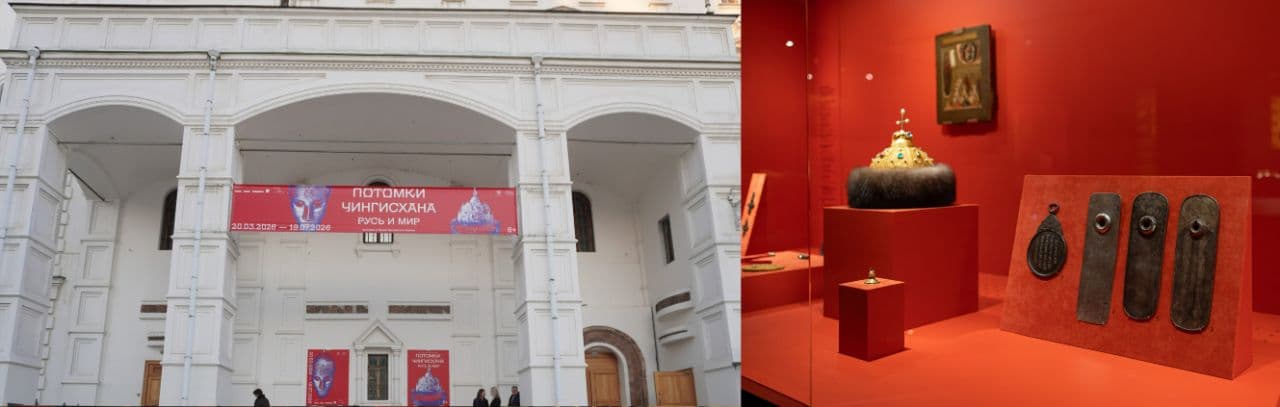

“CHINGGIS KHAAN’S DESCENDANTS: RUSSIANS AND THE WORLD” EXHIBITION HAS OPENED AT THE MOSCOW KREMLIN MUSEUM
The exhibition officially opened on March 19, 2026, at the Kremlin Museums in Moscow, the capital of the Russian Federation.
This exhibition is one of the major events organized to mark the 220th anniversary of the Kremlin Museums, as part of the initiatives under the year 2026, which was declared the “Year of National Unity” by the President of the Russian Federation, V.V. Putin. It is also the first official exhibition in Russia named after Chinggis Khaan, the founder of the Great Mongol Empire.
The exhibition, displayed in the Assumption Belfry of the Kremlin and the halls of the Patriarch’s Palace, was opened with remarks by the Director General of the Kremlin Museums, Elena Gagarina. In her speech, she emphasized that the exhibition reflects the historical relationship between Chinggis Khaan, his descendants, and Russia, presenting a multifaceted historical narrative. The exhibition features more than 150 unique and rare artifacts preserved in major Russian museums, libraries, and private collections.
At the opening ceremony, the Director of the Chinggis Khaan National Museum of Mongolia and Academician, S. Chuluun, delivered a speech. He noted that Chinggis Khaan and his dynasty established their own world in the vast steppes of Eurasia, created a great exchange of politics, economics, culture, science, and military art, and are the founders of the modern world, as many historians and scholars around the world agree. He emphasized that, as they established their authority across numerous countries in both the East and the West, they were not merely conquerors. Rather, they were able to project their heritage, high status, and influence broadly, while respecting the religions, traditional ways of life, cultural characteristics, and values of the peoples they governed. Historical artifacts and written sources clearly demonstrate this. It is true history that the legacy, influence, and great exchange left by Chinggis Khaan and his dynasty left traces in many countries of the world and influenced the subsequent fate of those countries.
The Moscow Kremlin Museums, with the support of the Russian Ministry of Culture, are presenting for the first time a large-scale exhibition dedicated to the descendants of Chinggis Khaan, the Tsardom of Russia of the 15th-17th centuries, which opens up a very important, interesting and new opportunity for the study of not only the history of the Russian people, but also of our history as Mongols. He also highlighted that the exhibition provides an opportunity to explore and reinterpret the legacy of the Mongol Empire and the Golden Horde, the relations between Russian and Tatar states, cultural influences, royal marriages, and court ceremonies offering new perspectives for understanding their shared history.
The exhibition features more than 150 selected exhibits related to the history of the Mongol Empire and the Golden Horde, which are kept in more than 10 Russian historical and cultural institutions, including the Moscow Kremlin Museum, the State Hermitage, the State Historical Museum, the Sh. Marjani Cultural Foundation, the National Library in St. Petersburg, and the Russian Museum. In other words, many exhibits that can be said to be historical relics directly related to the descendants of Chinggis Khaan preserved in present-day Russia are being made available to the public for the first time.
The exhibition is of historical significance as it provides an opportunity to take a completely new look at the role of the Mongol Empire in Russian historiography, the descendants of Chinggis Khaan in Russian history, and their relationship.
The exhibition “Chinggis Khaan’s Descendants: Russians and the World” will be on display at the Moscow Kremlin Museum until July 19, and a series of events are planned, including lectures, guided tours, and educational programs for the public.