


S.CHULUUN: HISTORY TEACHING IS NOT JUST A TOOL FOR TRANSMITTING CONTENT
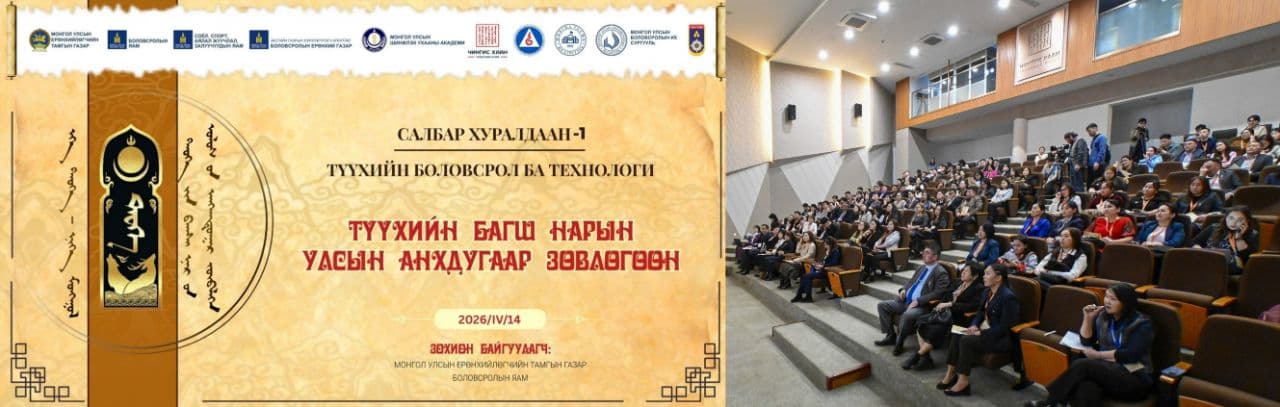
The "First National Conference of History Teachers" organized under the auspices of the President of Mongolia is currently being held in Ulaanbaatar, with more than 630 teachers from general education schools participating.
A sub-session was organized at the Chinggis Khaan National Museum to discuss the impact and importance of museum education on students' history education, the problems and solutions, and to develop recommendations. More than 150 teachers and researchers participated.
During this event, the director of the Chinggis Khaan National Museum, Academician S. Chuluun, delivered a keynote speech for teachers. He emphasized that while museums have traditionally preserved, protected, and promoted historical and cultural heritage, they now face the need to keep pace with modern education systems. Museums provide students with the opportunity to learn through "Seeing-Feeling-Comparing". International museum education standards are based not only on “observing” but also on “experiencing.” Adapting this approach to the cognitive characteristics of Mongolian students, allowing children to physically handle and experience historical artifacts, is important for strengthening knowledge. A museum should be an open environment where children can freely express themselves and gain scientific knowledge. He called for the intensive development of museum education, not just a means of conveying content, but how to use history in the process of creating people who understand society.
3 main problems facing the museum education sector: - One, Policy coherence: There is a lack of a unified policy to coordinate the school curriculum and museum activities; - Two. Methodology and system: The systematization of the curriculum to provide accessible information to children and youth is insufficient in museums; - Three. Funding: There is a lack of financial resources required to implement innovations and programs;
Developed countries such as South Korea, Japan, Russia, and European countries have introduced high technology into their museum sectors. Mongolia is also working to provide visitors with a more immersive experience by using VR, QR, and AR interactive technologies. For example, at the Chinggis Khaan National Museum, after children watch a virtual content experience about “Khubilai Khan’s storm” in a virtual room, they then enter the exhibition hall and see ship remnants and historical artifacts from that period. This significantly enhances their level of historical understanding.
Participants agreed that in the future, by strengthening collaboration between museum staff and teachers and creating a technology-based interactive environment, Mongolia’s museum sector has the potential to move to a new stage of development.