


FOR THE FIRST TIME, LEADERS OF LEADING ASIAN AND EUROPEAN MUSEUMS ARE GATHERING IN MONGOLIA
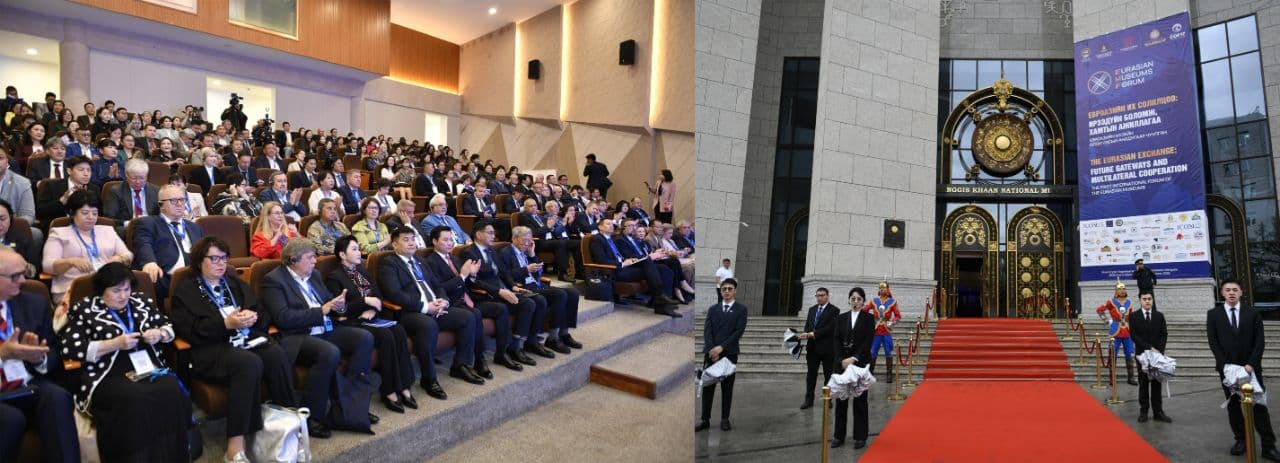
With the noble goal of protecting, studying, and sharing the historical and cultural heritage of mankind, more than 70 museum directors from over 20 countries gathered at the Chinggis Khaan National Museum on June 15, 2026.
Under the patronage of the President of Mongolia, the conference “The Great Eurasian Exchange: Future Opportunities and Cooperation” has begun discussions aimed at elevating museum cooperation among Eurasian countries to a new level. Participants are exchanging knowledge and experience while exploring numerous aspects of museum development, including the preservation, protection, promotion, and transmission of humanity’s remarkable cultural heritage to future generations.
The conference was opened by Academician S. Chuluun, Director of the Chinggis Khaan National Museum. A. Uilstuguldur, Chief of Staff of the Office of the President of Mongolia, delivered the President’s greeting. The conference was then officially inaugurated with a performance of “Sersen tal” (The Awakened Steppe), one of the masterpieces of Mongolian musical art, composed by Mongolia’s Hero of Labor and State Prize Laureate B. Sharav.
Academician S. Chuluun stated: “The Chinggis Khaan National Museum may be one of the youngest museums in the Eurasian region. Therefore, this conference is a vital opportunity for us to exchange fresh knowledge, learn from past experiences, and seek paths for future cooperation alongside regional and international museums that boast decades of experience. I sincerely thank all of you who have come to honor us. Mongolians are a people who have continuously passed down their nomadic civilization, preserved their unique way of life, endured extreme climates, and shaped a great history. Today, world history rightly shows that the Mongols did not merely conquer; they respected the religion, language, and lifestyle of others, managed conflicts, valued intellectual talents, and built enduring structures. A key role of the Chinggis Khaan National Museum is to accurately present and understand history, examining every issue within its proper historical context."
The conference is attended by approximately 200 representatives, including Minister of Culture, Sports, Tourism and Youth J. Aldarjavkhlan, Minister of Foreign Affairs B. Battsetseg, presidential advisers, scholars, researchers, and other officials. The conference will continue for five days. Museum leaders from Eurasian countries will participate in specialized sessions covering museum development, policy and operations, the preservation and protection of nomadic cultural heritage, current challenges, new opportunities for cooperation, international relations, museums in the modern era, technology, and innovation. They will discuss shared goals, proposals, and future opportunities.
At the conclusion of the conference, the Eurasian museum leaders will visit and learn about the heritage sites of Karakorum, the capital of the Mongol Empire, Erdene Zuu Monastery, monuments of the Uyghur Khaganate and the Turkic Khaganate, nomadic cultural traditions, and other museums throughout Mongolia.
At the conclusion of the conference, the delegates will tour the historic sites of the Eurasian Museum network. Their itinerary includes visits to Kharkhorum, the ancient capital of the Mongol Empire, as well as the Erdene Zuu Monastery, the historical sites of the Uyghur and Turkic Khanates, and other cultural heritage museums.