


ACADEMICIAN S. CHULUUN: “FOR THE FIRST TIME, TEACHINGS OF CHINGGIS KHAAN HAVE BEEN DISCOVERED IN AN ARCHAEOLOGICAL EXCAVATION”
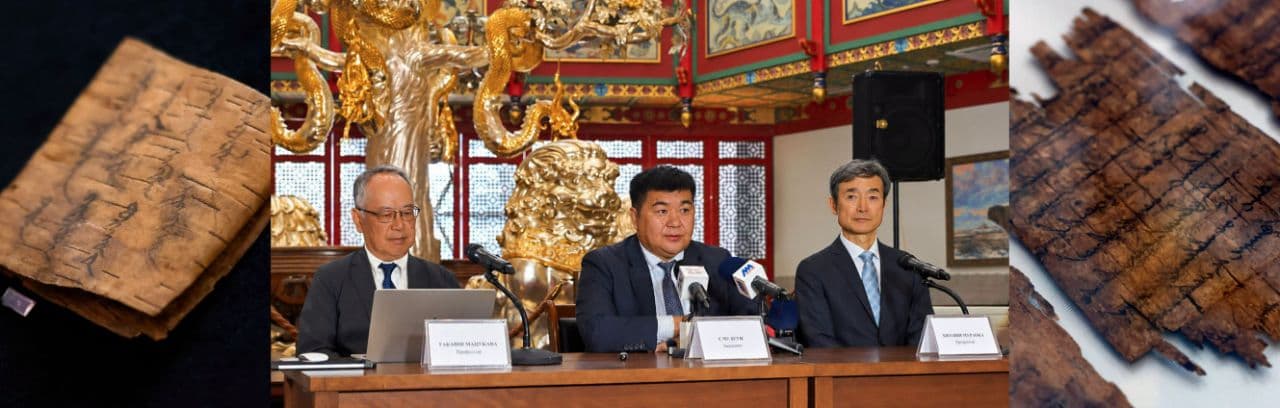
Under the framework of the Mongolian-Japanese “Inscriptions” project led by the Institute of History and Ethnology at the Mongolian Academy of Sciences, archaeological excavations were conducted in 2025-2026 at Olon Sum, located in Uyanga soum, Ovorkhangai Province. Academician S. Chuluun alongside researchers Professor Takashi Matsukawa and Hitoshi Muraoka presented the highlighted results of the 2026 archaeological research on September 15, 2026.
The research was led by Dr. L. Erdenebold on the Mongolian side in 2025, Academician S. Chuluun from 2026, and Professor Takashi Matsukawa on the Japanese side, with a research team headed by archaeologist E. Urtnasan. They uncovered “new primary source materials for the study of Mongolian Buddhist history and written culture.”
Archaeological excavations were conducted at a large structure located in the eastern part of the site and at a smaller building situated in front of it. The larger structure consisted of a central hall, five bases for Buddhist statues, and a circumambulatory pathway surrounding them. Remnants of wall paintings depicting Buddhist figures, mountains, clouds, snakes, and floral motifs in multiple colors were also discovered. Researchers noted that this represents an exceptionally important archaeological site for the study of Buddhism in Mongolia.
Furthermore, numerous items were uncovered during the excavation, including various unbaked clay deity fragments, a Buddha head and feet, a porcelain cup used as a shunshig (consecration/relic vessel), an iron artifact depicting a horse rider, 21 prayer beads made of precious stones, and fragments of red sandalwood. Dating analysis conducted in Japan in 2025 determined that the temple dates back to the late 16th to early 17th century, aligning with the era of Erdene Zuu, Mongolia’s first monastery.
The most notable highlight of the 2026 research was the discovery of around 30 fragments of birch-bark books written in the Traditional Mongolian script across two excavation sites. Conservators at the Chinggis Khaan National Museum performed the initial restoration work. First readings reveal that the text consists of religious texts, astrology, and moral teachings.
Among these discoveries is a particularly significant passage containing teachings and maxims that Chinggis Khaan gave to his sons and younger brothers, which researchers describe as a first-of-its-kind discovery from an archaeological excavation. Researchers have determined that these teachings correspond to passages recorded in the Lu. Altan Tobchi. Further detailed study, conservation and preservation work, and dating of the manuscripts are now underway.
Based on these artifacts, structural layouts, wall paintings, and birch-bark manuscripts, Olon Sum is distinguished as one of Mongolia's earliest monasteries and a major historical center of architecture, religion, and written culture.