



WORLD-RENOWNED MASTERPIECES OF CLASSICAL ART TO BE PRESENTED IN MONGOLIA
The Chinggis Khaan National Museum continues to advance its commitment to fostering international cultural cooperation and promoting access to the world’s artistic heritage. Since its establishment, the Museum has brought distinguished masterpieces of international art to Mongolia, while steadily strengthening partnerships with leading museums and cultural institutions around the world.
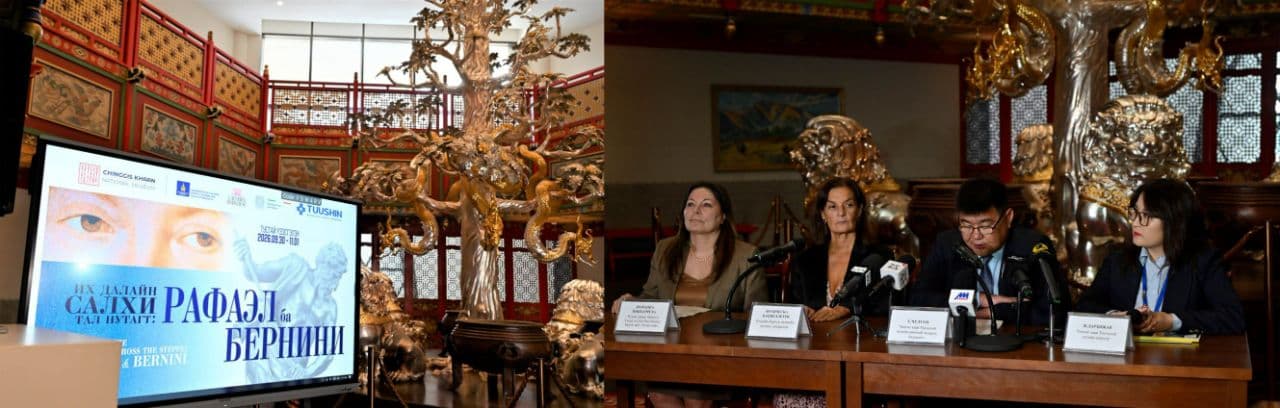
In a further milestone in this ongoing cultural cooperation, the Chinggis Khaan National Museum, in partnership with the Galleria Borghese of Rome, Italy, will present a special exhibition entitled “The Wind of the Great Ocean Across the Steppe: Raphael and Bernini.” At a press briefing, Mr. S. Chuluun, Director General of the Chinggis Khaan National Museum; Professor Francesca Cappelletti, Director of the Galleria Borghese, H.E. Ms. Giovanna Piccarreta, Ambassador Extraordinary and Plenipotentiary of the Italian Republic to Mongolia, and Mrs. J. Darkhijav, Curator of the exhibition, provided information on the forthcoming exhibition.
The exhibition will bring together two distinguished masterpieces representing major periods in European art: Raphael Santi’s renowned “Portrait,” representing the High Renaissance, and “Neptune” by Gian Lorenzo Bernini, a distinguished work of the Baroque period.
Bringing these works together provides a unique opportunity to explore the artistic dialogue between two important periods of European cultural history. Raphael’s work conveys a sense of strength through composure and inner contemplation, while Bernini’s sculpture expresses movement, dynamism, and heightened emotion. Their presentation within a single exhibition offers visitors an opportunity to appreciate the distinctive artistic achievements of the Renaissance and Baroque traditions.
Speaking at the briefing, Mr. S. Chuluun, Director of the Chinggis Khaan National Museum, noted that the Museum had presented the exhibitions “Zanabazar: From Mongolia to the Global Baroque” and “Zanabazar: The Eye of the Steppe” in Rome and Turin, Italy, earlier this year. He emphasized the historical significance of the parallel artistic achievements of Gian Lorenzo Bernini and the renowned Mongolian sculptor Undur Gegeen Zanabazar, who were contemporaries in the seventeenth century. While Western Europe was experiencing a flourishing of classical sculpture and architecture through the works of artists such as Bernini, Zanabazar was simultaneously creating his own masterpieces in East Asia.
The exhibition marks a significant occasion for cultural exchange, as these celebrated original works are being presented in Mongolia and, notably, in Asia for the first time.
Mr. Chuluun further highlighted that the establishment and development of the Chinggis Khaan National Museum has enabled Mongolian audiences to experience original masterpieces of world art and culture in their home country. He noted that the Museum’s capacity to host international exhibitions of this nature demonstrates its commitment to international museum standards and to advancing public access to cultural and artistic education.
The Chinggis Khaan National Museum has likewise continued to promote Mongolia’s cultural heritage internationally. Its special exhibition “Chinggis Khaan: How the Mongols Changed the World” has been presented in France, Italy, Switzerland, the Czech Republic, and the United Kingdom, and is scheduled to be presented in Germany in October.
Mr. Chuluun expressed his appreciation to Professor Francesca Cappelletti, Director of the Galleria Borghese, for accepting the Museum’s invitation and making possible the presentation of these important works in Mongolia, as well as to H.E. Ambassador Giovanna Piccarreta for her continued support of the initiative.
Professor Francesca Cappelletti welcomed the continued expansion of cooperation between the two institutions and expressed her appreciation for the opportunity to share works from the Galleria Borghese’s distinguished collection with the Mongolian public. She highlighted the presentation of Bernini’s “Neptune” and an original work by Raphael, together with its preparatory drawing, as an important contribution to cultural exchange and the promotion of international artistic dialogue.
H.E. Ambassador Giovanna Piccarreta described the exhibition as a forward-looking cultural initiative that provides Mongolian audiences with an opportunity to encounter outstanding masterpieces of Italian art. She expressed her appreciation to Mr. S. Chuluun and Professor Francesca Cappelletti for their efforts in bringing the exhibition to Mongolia and emphasized that such initiatives contribute to deepening bilateral cultural relations and strengthening the longstanding friendship between Mongolia and Italy through cultural exchange.
The exhibition will be presented for one month in the Special Exhibition Hall on the ninth floor of the Chinggis Khaan National Museum. Throughout the exhibition period, the Museum will implement the daily art education program “World Classics in My Frame,” designed to enhance visitors’ cultural, aesthetic, and educational experience. A dedicated catalogue and a range of exhibition-related merchandise will also be available, providing visitors with further insight into the history, artistic characteristics, and significance of the two masterpieces.
Bringing internationally acclaimed masterpieces to Mongolia and organizing exhibitions of this calibre require extensive professional expertise and substantial resources, including specialized insurance, international transportation, conservation-standard packaging, installation and deinstallation procedures, as well as specially controlled exhibition cases, gallery conditions, temperature, humidity, and other technical requirements.
In accordance with international museum standards and with the aim of making world-class cultural heritage accessible to the public, the Chinggis Khaan National Museum will present the exhibition with an admission fee of MNT 20,000. The exhibition will officially open at 11:40 a.m. on Wednesday, 30 September 2026.
The Galleria Borghese, located in Rome, is widely recognized as one of Italy’s leading museums and a major destination for visitors seeking to experience the country’s artistic heritage. The building was constructed between 1605 and 1621 as a private villa for Cardinal Scipione Borghese.
Today, the Galleria Borghese houses an exceptional collection spanning the Renaissance, Baroque, and Neoclassical periods, including masterpieces by such internationally renowned artists as Caravaggio, Bernini, Canova, Raphael, and Titian.
A significant part of the Galleria Borghese’s collection comprises works by Gian Lorenzo Bernini (1598–1680), one of the foremost figures of Baroque sculpture. Bernini began creating some of his most important large-scale sculptural works under the patronage of Cardinal Scipione B