


THE INTERNATIONAL CONFERENCE ON GENGHIS KHAN STUDIES WAS HELD IN BERLIN
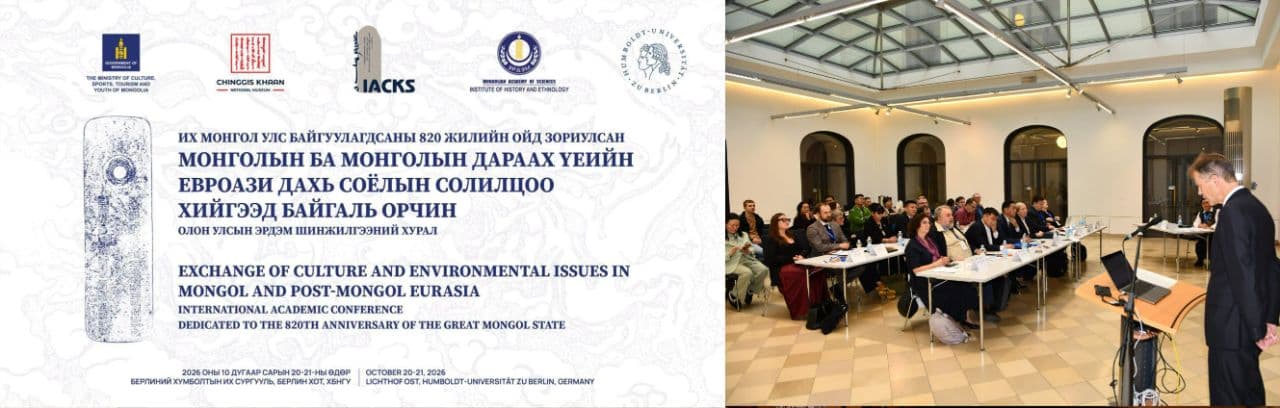
The Third International Academic Conference on Genghis Khan Studies, titled “Culture and Environmental Issues in Mongol and Post-Mongol Eurasia” was successfully organized by the National Museum of Chinggis Khaan on October 21, 2026, at Humboldt University of Berlin, Germany.
The International Association for Chinggis Khaan Studies is a non-governmental international academic organization that voluntarily brings together scholars specializing in the Mongol Empire and Genghis Khan, as well as Mongolian studies associations and research centers from around the world.
The conference discussed the diverse and complex nature of Eurasian culture during the Mongol and post-Mongol periods since the 13th century, focusing particularly on how concepts and forms of knowledge were disseminated and circulated within various cultural and environmental contexts. Opening the conference, Minister of Culture, Sports, Tourism and Youth J. Aldarjavkhlan stated that the event would contribute to the scientifically grounded study of intercultural relations, knowledge exchange, and diverse cultural influences across Eurasia dating back to the Mongol Empire, while also expanding international academic cooperation.
Beate Lütke, Vice-President for Teaching and Student Affairs at Humboldt University of Berlin, also attended the conference and wished the participants success.
During the conference, academician S. Chuluun, Director of the National Museum of Chinggis Khaan, introduced the activities of the International Association for Chinggis Khaan Studies. He noted that, thanks to the dedicated efforts and scholarly contributions of successive generations of researchers studying the Mongol Empire, it has become increasingly clear that Chinggis Khaan and his successors were not merely conquerors, but also builders of civilizations, promoters of enlightenment, establishers of peace, and pioneers of development and progress.
Although the association was established relatively recently, it held its General Assembly in 2023 and its international academic conference in 2024. In cooperation with the National Museum of Chinggis Khaan, it has worked with Mongolian and international scholars to conduct comprehensive research into Chinggis Khaan’s life and biography, his exceptional personal abilities and strategic intelligence, and his contributions to the history of Mongolian statehood.
The association has also collaborated with scholars from Mongolia and abroad on international research into the multifaceted history of the Mongol Empire, including its conquests, the Mongols’ governance of both nomadic and settled societies; their attitudes toward their own and other cultures, arts, and religions; and the many dimensions of knowledge and intellectual exchange.
Jan Bemmann of the University of Bonn Rheinische Friedrich-Wilhelms-Universität delivered the keynote presentation entitled “Karakorum: Creating an Imperial Capital on the Open Steppe.”
A total of 15 scholars from seven countries Germany, Italy, Hungary, the United Kingdom, Poland, Austria, and Mongolia presented 14 papers, followed by active academic discussions.
The presentations covered a wide range of topics, including intercultural relations reflected in archaeological discoveries from Karakorum and Khara Balgas, the artistic heritage of the Ilkhanate, the teachings of Chinggis Khaan, gerege paiza and calligraphy, horse tack and equipment of the Mongol Empire, the decimal system of the Great Mongol State, Marco Polo's travel notes, and new archaeological evidence of the traces of the Mongols in the Great Hungarian Plain in 1241. This conference examined cultural exchange and environmental issues of the Mongol Empire era from a new perspective based on multidisciplinary research, strengthening cooperation between Mongolia and leading European universities and research institutions, and making a valuable contribution to the international development of Chinggis Khaan studies.